
Elevating Stability in Financial Success
Blog
23 February
2026
Explainable AI (XAI) in FP&A - Why Transparency Matters as much as Accuracy?
AI and ML are quickly becoming part of the finance team’s everyday toolkit. It helps flag unusual patterns, forecasting outcomes, and keep an eye on risk long before issues escalate. But as these systems get smarter, they also get harder to explain and that is where things get tricky.
In finance, a number is not useful if no one can explain how it was produced. If you cannot walk someone through the logic behind it, you cannot truly stand behind it.
Finance and accounting live in a world of scrutiny. Leaders ask questions, auditors dig deep and regulators expect clarity. Every decision needs to be backed by reasoning that makes sense to people, not just machines.
That is why Explainable AI (XAI) is not optional. It is the difference between using AI as a black box and using it as a tool you can trust.
Understanding Explainable AI (XAI)
Explainable AI is about more than just producing an answer. It is about being able to clearly explain why that answer exists, in plain language that people can actually understand.
Traditional AI often falls short. It can feel like a black box, data goes in, numbers come out, and the reasoning in between is invisible. Finance doesn’t work that way. Finance is closer to Excel: you can see the formulas, you can trace the drivers and you can follow the logic from start to finish.
Explainable AI bridges this gap. It brings the power of machine learning together with the transparency finance teams rely on. So, insights are not just accurate, but understandable and defensible too. Explainable AI doesn’t replace financial logic, rather it reinforces it.
Black-box AI output: Q3 revenue forecast reduced by 4.2%.
Explainable AI output: Q3 revenue forecast reduced by 4.2%, driven primarily by a 6% volume decline in customers in North America, partially offset by price increases in enterprise accounts.
The Critical Role of Explainability in Finance
Finance decisions carry real weight. They shape earnings guidance, influence how companies communicate with investors, determine where capital gets deployed, and flow directly into regulatory filings.
Because of that, finance doesn’t have the same flexibility as functions like marketing or product analytics. It operates under strict governance and constant oversight. They expect financial outputs to be clear, consistent, and defensible. Means, the numbers must be explainable, repeatable and auditable
When a forecast changes in a meaningful way, finance teams are immediately expected to answer tough questions:
- What changed?
- Why did it change?
- Does the change make sense?
- Can we recreate the result?
If an AI model can’t help answer those questions, it doesn’t make finance more efficient, it makes it riskier.
What is Financial Explainable AI (FinXAI)?
A recent paper, “A Comprehensive Review on Financial Explainable AI” introduces the concept of FinXAI - a specialized approach to explainable AI tailored for financial applications. What distinguishes FinXAI is its inherently multidisciplinary nature. Effective explanations demand not only technical rigor in model interpretability, but also deep collaboration with financial domain experts to ensure insights are credible, contextually relevant, and persuasive to the intended audience.
Audience specificity sits at the core of FinXAI. Explanations must be deliberately designed to address the expectations and decision-making needs of different stakeholders - whether analysts, auditors, regulators, or business leaders - making FinXAI fundamentally audience-centric by design.
The paper further proposes a structured framework that treats the design of an XAI solution as a sequential decision-making process, illustrated in the figure below.
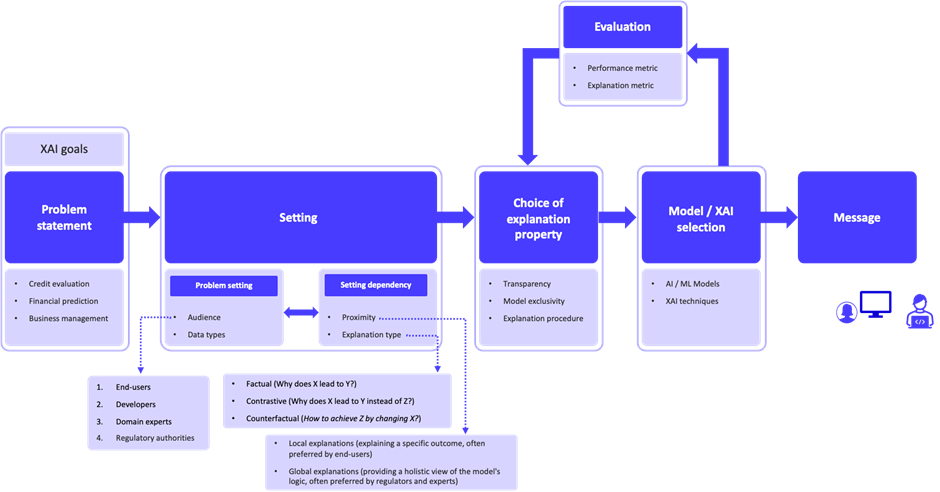
Source : https://link.springer.com/article/10.1007/s10462-024-11077-7#Sec3
Why Black-Box AI Falls Short in Financial Applications?
Black-box AI models often struggle in real finance situations because finance data is constantly changing.
Things like mergers, pricing updates, seasonality shifts, one-time events, or even manual journal entries can quickly throw a model off.
An AI model might still flag a variance, but that’s only part of the story. It may not be able to explain:
- Is the change coming from volume, price, or mix?
- Is this a one-time issue or something ongoing?
- Does this actually reflect what’s happening in the business?
Strong accuracy during training doesn’t guarantee the model will hold up when conditions change. And ironically, those moments of change are exactly when finance teams need AI they can trust the most.
Why FP&A Functions Depend on Explainable AI?
1. Predictive Forecasting
A forecast without context is just a number on a spreadsheet. When FP&A teams present quarterly projections to the CFO, the first question is never "what's the number?", it is always "why?"
Effective forecasting models must decompose their predictions into meaningful drivers. Revenue growth of 8% tells an incomplete story. The real insight comes from understanding whether that growth stems from volume increases, price adjustments, or shifts in product mix. Similarly, distinguishing between improvements in internal operational performance and favorable external market conditions separates genuine business transformation from fortunate timing. The model must also isolate the baseline business trajectory from one-time events, a major contract win or a temporary supply chain disruption.
This level of explainability transforms how finance teams operate. In leadership reviews, they can defend their projections with conviction, pointing to specific drivers rather than relying on black-box outputs. Scenario planning becomes genuinely meaningful when teams can test "what if volume drops 10%" or "what if the product mix shifts toward lower-margin items" and see how each lever affects the outcome. Most importantly, transparency builds trust. When executives understand how a model arrives at its conclusions, they're far more likely to incorporate those insights into strategic decisions.
The difference between a forecast and a trusted forecast lies entirely in the explanation.
2. Variance & Anomaly Detection
Financial close and monthly review processes typically involve critical questions: What changed?, Where did the change occur?, Why did the shift happen? etc… Explainable AI transforms this investigative work by directly attributing variances to specific cost centers, accounts, business units, and time periods. This capability proves essential because anomaly detection without proper explanation becomes nothing more than noise (data points that raise alarms but provide no actionable insight into their root causes).
3. Risk, Compliance & Controls
When AI steps into fraud detection and controls monitoring, it faces a critical challenge: regulatory scrutiny. Every alert needs a clear explanation. The underlying logic demands thorough documentation. Thresholds must have solid justification.
Without these elements, AI outputs fail audit and compliance reviews. Regulators won't accept black-box decisions. In regulated environments, explainability is not a nice-to-have, it is the foundation that separates experimental technology from trusted risk management tools.
How Explainable AI Works in Practice?
Explainable AI typically combines interpretable models with explanation techniques.
On the model side, this often means using approaches like:
- Interpretable regression models
- Tree-based models (like gradient boosting)
- Hybrid models (ML + business rules)
To explain the results, teams use techniques such as:
- Feature importance
- Driver attribution (like LIME, SHAP values)
- Scenario sensitivity analysis
A critical distinction to note is Explaining a model is not the same as explaining the business.
Rethinking the Explainability Vs Accuracy Trade-Off
There is a common belief that explainable AI is less accurate than black-box models. In finance, that way of thinking misses the point. Finance doesn’t optimize for perfect accuracy alone. It values stability, consistency, reasonableness and trust
A forecast that is 92% accurate but can’t be explained is often less useful than one that is 88% accurate and clearly understood. Because people make decisions based on confidence and clarity, not tiny differences in precision. Explainable AI leads to better decisions, even if it means giving up a small amount of raw accuracy.
Designing AI Outputs for Auditors and CFOs
For AI to be ready for real-world use in FP&A, its outputs need to be clear and reliable. That means they should show clear driver attribution, consistency over time and explanations of what happens when inputs change. It needs to pass a critical test: can someone other than the data scientist who built it actually understand what it is doing? The answer lies in two fundamental pillars, transparent outputs and rigorous documentation.
But transparency doesn't end with the model's output screen. Behind every production model should sit a comprehensive documentation trail that answers the fundamental questions any auditor, regulator, or executive might ask. What problem is this model actually solving? Where does the training data come from, and can we trust its provenance? What assumptions did we bake into the model's architecture? And critically, what are its limitations - the scenarios where we know it might stumble?
This is not just good practice, it is the foundation of enterprise-grade AI. When explainability is embedded from the start, it transforms AI from a black box into a strategic asset that strengthens Management Review Controls, supports SOX compliance, and makes audit conversations straightforward rather than defensive. The result is AI that doesn't just perform well in testing, but it performs reliably under the scrutiny of real-world financial governance.
The Role of Data Engineering in Explainable AI
Picture a typical monthly forecast review meeting unfolding in the CFO's office. The CFO opens with a pointed question: "Why did the forecast miss by 15% again?" The Finance Director's response is telling: "The team spent most of the month pulling numbers from five different systems, cleaning up inconsistencies, and chasing down last-minute updates." The CFO's frustration becomes palpable: "So the analysts are spending more time fixing the numbers than figuring out what they mean?!"
This scenario captures a widespread challenge facing finance teams today. Analysts find themselves trapped in endless data reconciliation cycles rather than delivering the strategic insights that drive business decisions. This is precisely where Data Engineering (DE) becomes essential.
Data engineering plays a critical role in all AI initiatives, as it involves collecting, cleansing and transforming data into a suitable format for AI algorithms to process. Effective data engineering ensures that AI models have access to high-quality, trusted and governed data, thereby proving the accuracy and performance of AI for model training. Modern businesses embarking on AI and analytics ventures often confront a host of data preparation challenges. It is essential to navigate these hurdles skillfully to leverage AI’s full potential.
Explainability collapses without strong data foundations. In FP&A the requirements include
- Well-defined financial dimensions
- Consistent metric definitions
- Versioned data models
- End-to-end lineage
If finance data lacks Clean hierarchies, Reproducible pipelines and Semantic consistency then AI explanations become unreliable, regardless of model quality. In short, AI is not a shortcut around data engineering, it depends on it.
Common Mistakes Companies Make with Explainable AI
Explainability should simplify decision-making, not add cognitive load. This list will go over some of the most common mistakes. Keep in mind that this list is not exhaustive, and each of the unique workflows might have other problems and vulnerabilities.
- Treating explainability as a UI feature
- Producing explanations that don’t map to finance logic
- Letting data science own the narrative instead of finance
- Ignoring model drift and explanation drift
- Overcomplicating outputs executives won’t read
From Explainable AI to Decision Intelligence
The next step is not just about explaining numbers, but explaining decisions. Finance is shifting from simply saying “Here’s the forecast” to clearly explaining “Here’s the impact if we act (or if we don’t act)”
The future of finance AI will provide:
- Narratives built around key drivers
- Clear confidence ranges
- Outcomes across different scenarios
- AI-generated management commentary
In this future, explainability isn’t a compliance burden, it’s a competitive advantage.
This is not theoretical but a total reimagining of the CFO daily reality. By trading retrospective reporting for forward-thinking strategy, FP&A teams are operating at scale and stress testing scenarios in minutes rather than weeks. The shift is absolute because Explainable AI has empowered finance from a narrator of the past into an architect of the future. By answering real world questions when timing actually matters, finance is no longer just a support function but the primary driver of business performance.





.png)

